Poitrasson-Rivière, A., Moody, J.B., Renaud, J.M. et al. Integrated myocardial flow reserve (iMFR) assessment: optimized PET blood flow quantification for diagnosis of coronary artery disease. Eur J Nucl Med Mol Imaging 51, 136–146 (2023).
Description:
This study investigates the development and validation of integrated Myocardial Flow Reserve (iMFR), an innovative combination of Myocardial Blood Flow (MBF) metrics and relative perfusion quantification.
Using data from a clinical registry of 1,044 patients and 231 participants in the Flurpiridaz 301 trial, the researchers aimed to distinguish obstructive epicardial coronary artery disease (CAD) from microvascular dysfunction and diffuse atherosclerosis. The iMFR quantification results were evaluated against invasive coronary angiography (ICA) findings. Researchers found iMFR improved diagnostic accuracy for obstructive stenosis, compared to standard quantitative perfusion approaches. This approach also revealed that focally impaired perfusion correlated strongly with high-risk CAD anatomy, while diffuse perfusion impairment indicated a lower likelihood of obstructive CAD, particularly in the absence of transient ischemic dilation (TID).
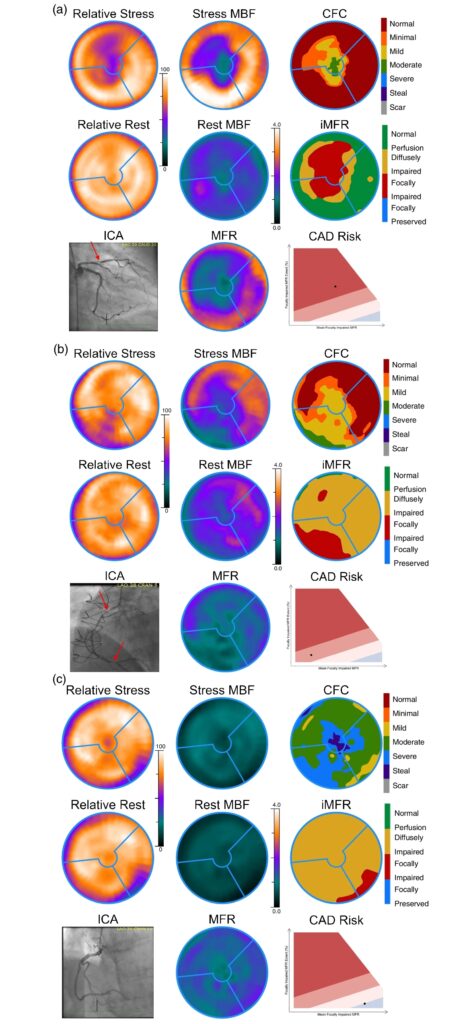
Three example cases highlighting how focally impaired myocardium predicts obstructive CAD. The axes labels and units of the CAD Risk plots are shown in Fig 2. Patient (a) is a 66-year-old female, with a BMI of 29.2 kg/m2. The patient presented for PET imaging with chest pain and risk factors of hypercholesterolemia and family history of CAD. ICA showed 90% stenosis in the mid LAD. Patient (b) is a 33-year-old female with a BMI of 32.0 kg/m2. The patient presented for PET imaging with known CAD (including a previous stent) for pre-operative risk assessment. The patient had coronary risk factors of hypertension, family history of CAD, and obesity. ICA revealed lesions in the proximal and distal RCA. Finally, patient (c) is an 88-year-old male with a BMI of 21.2 kg/m2. The patient presented for PET imaging with arrhythmia and an abnormal stress test. ICA suggested microvascular disease but no obstructed CAD.
Clinical Relevance:
The development of iMFR has significant clinical implications, providing a more nuanced diagnostic tool for differentiating between types of coronary artery disease. The improved diagnostic accuracy for obstructive CAD using iMFR can lead to better identification and timely intervention for patients with high-risk anatomy, such as left main or three-vessel disease. Additionally, the ability to rule out high-risk CAD in cases of diffuse perfusion impairment without TID reduces the likelihood of unnecessary invasive procedures.
Partners in Research:
INVIA Medical Imaging Solutions, the University of Michigan, GE Healthcare, Houston Methodist, and Northwestern University collaborated on this research.