Poitrasson-Rivière, A., Moody, J.B., Hagio, T. et al. Reducing motion-correction-induced variability in 82rubidium myocardial blood-flow quantification. J. Nucl. Cardiol. 27, 1104–1113 (2020).
Description:
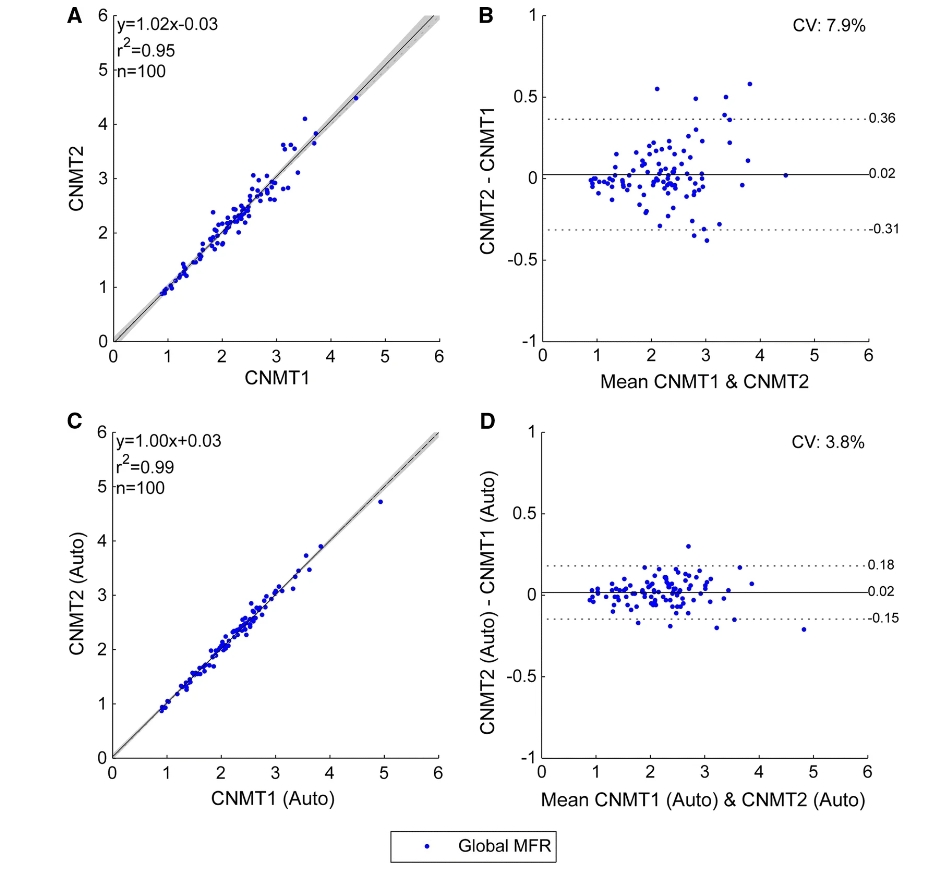
Researchers evaluated an automated motion-correction algorithm against manual motion correction in 100 dynamic 82Rb PET myocardial perfusion studies.
Two technologists were randomized to either manually correct or manually review and adjust automated corrections, with the primary outcome being inter-rater variability for myocardial blood flow (MBF) and myocardial flow reserve (MFR). The study found that the limits of agreement for MBF and MFR between the technologists significantly decreased with automated correction and processing time was reduced by an average of one minute per study.
Clinical Relevance:
Automatic motion correction resulted in an improvement of 40% to 50% on inter-user agreement for MBF and MFR. It also reduced processing time, indicating automated motion correction can improve workflow efficiency.
Partners in Research:
INVIA Medical Imaging Solutions and the University of Michigan collaborated on this research.